

Key Findings
- Taxpayers reported just under $15 trillion of total income on their 2022 tax
- About 65 percent ($9.7 trillion) consisted of wages and salaries, and nearly 80 percent of all taxA tax is a mandatory payment or charge collected by local, state, and national governments from individuals or businesses to cover the costs of general government services, goods, and activities. filers reported earning wage income.
- Retirement accounts, such as 401(k)s and pensions, are important sources of capital income for the middle class, accounting for nearly $1.5 trillion of income in 2022.
- Combined with taxable Social Security benefits of nearly $459 billion, retirement income accounted for nearly $1.8 trillion of income in 2022.
- Business income is another large component of reported personal income. Businesses that report income taxes through the individual income taxAn individual income tax (or personal income tax) is levied on the wages, salaries, investments, or other forms of income an individual or household earns. The U.S. imposes a progressive income tax where rates increase with income. The Federal Income Tax was established in 1913 with the ratification of the 16th Amendment. Though barely 100 years old, individual income taxes are the largest source system, like S corporations, sole proprietorships, and partnerships, accounted for nearly $1.6 trillion of income in 2022.
- Investment income consisting of net capital gains, taxable interest, and ordinary dividends accounted for nearly $1.8 trillion of income in 2022, down significantly from $2.6 trillion in 2021, driven by near-record-high capital gains realizations that year.
- Several categories of income changed significantly from 2021 to 2022, most notably capital gains (declining due to a slumping stock market) and unemployment compensation (declining due to both lower unemployment and the expiration of enhanced unemployment benefits passed during the COVID-19 pandemic).
Introduction
The individual income tax is the federal government’s largest source of revenue. Taxpayers filed more than 161 million individual income tax returns for tax year 2022, the fifth year under the changes made by the 2017 Tax Cuts and Jobs Act (TCJA).
Each household with taxable income must file a return to the Internal Revenue Service (IRS). On the IRS individual income tax form (Form 1040), taxpayers list and add all sources of taxable income to reach total income. From there, taxpayers figure their deductions and credits to determine tax liability and tax owed or refunded.
This report will focus on sources of reported total income on Form 1040, which amounted to $14.98 trillion. Reviewing reported income helps understand the composition of the federal government’s revenue base and how Americans earn their taxable income. We divide income into four major categories—wages and salaries, business income, investment income, and retirement income—and review each category for tax year 2022. It is important to note that tax data comes with some limitations, namely that not all economic activity is found on personal income tax forms. For example, employer-provided health insurance and returns to owner-occupied housing are excluded. Both are substantial components of economic output that do not appear on income tax returns. As broad economic aggregates, though, the categories of income established on Form 1040 are still useful and instructive.
Table 1. Top 10 Sources of Total Income on US Individual Income Tax Returns, Tax Year 2022, in Billions
Source: IRS, “SOI Table 1.4.”
Wages and Salaries Make Up $9.7 Trillion of Personal Income
Wages and salaries comprise the largest overall source of total income. For most tax filers in the US, the largest income number on Form 1040 appears on the line where they report wages, salaries, tips, and other compensation for their work. In other words, most Americans report earning labor income, and most of their income comes from labor. In total, more than 128 million tax filers in 2022 reported $9.7 trillion in wage income—65 percent of total income. That compares to $9.0 trillion and 61 percent in 2021.
The amounts reported on Form 1040 reflect most, but not all, labor compensation. For example, employer contributions to Social Security and payments for employee health benefits are both excluded from income taxation.
Wage and salary income is taxed at a progressive rate schedule with rates ranging from 10 percent to 37 percent. The top rate of 37 percent was levied on taxable income above $539,900 for single filers and above $647,850 for married couples filing jointly in tax year 2022.
Business Income Makes Up Nearly $1.6 Trillion of Personal Income
In the US, pass-through entities are the dominant tax filing structure for businesses, so labeled because the income is “passed through” to individual owners’ tax returns using schedules C, E, and F, rather than taxed at the business level.
Unlike corporations subject to the corporate income taxA corporate income tax (CIT) is levied by federal and state governments on business profits. Many companies are not subject to the CIT because they are taxed as pass-through businesses, with income reportable under the individual income tax., pass-through businessA pass-through business is a sole proprietorship, partnership, or S corporation that is not subject to the corporate income tax; instead, this business reports its income on the individual income tax returns of the owners and is taxed at individual income tax rates. income is taxed as ordinary income on owners’ personal tax returns at the same progressive rate schedule as salaries and wages. In 2022, taxpayers could claim the TCJA’s temporary 20 percent tax deductionA tax deduction allows taxpayers to subtract certain deductible expenses and other items to reduce how much of their income is taxed, which reduces how much tax they owe. For individuals, some deductions are available to all taxpayers, while others are reserved only for taxpayers who itemize. For businesses, most business expenses are fully and immediately deductible in the year they occur, but ot for pass-through business income, notwithstanding certain limits and qualifications.
Pass-through firms employ most of the private-sector workforce in the US and account for most business income. Partnerships and S corporations reported more than $1 trillion of net income less losses in 2022. Individuals reported an additional $410 billion of business or professional income less losses (sole proprietorship income). Together, business income less losses totaled about $1.6 trillion when including income from estates, farms, trusts, rents, and royalties, compared to $1.5 trillion in 2021.
Investment Income Makes Up Nearly $1.8 Trillion of Personal Income
Overall taxable investment income, consisting of taxable interest, ordinary dividends, capital gains income, and the sale of property, amounted to $1.8 trillion in 2022, compared to $2.6 trillion in 2021. Taxpayers reported nearly $412 billion of taxable ordinary dividends, $134 billion of taxable interest, and $32 billion of net gains from sales of property other than capital assets, such as certain real business property or copyrights. Capital gains realizations decreased significantly to $1.2 trillion, down by almost 40 percent compared to a 40-year high in 2021 when capital gains realizations exceeded $2 trillion.

Taxable labor compensation is much larger than taxable investment income. While the returns to corporate stock and other capital assets found on individual income tax returns are substantial, they remain relatively small compared to the $9.8 trillion of taxable labor income earned in tax year 2022.
Some investment income is subject to ordinary income tax rates, and some is subject to a separate schedule with lower tax rates. Taxable interest, ordinary dividends, and short-term capital gains (gains realized on assets held for less than one year) are taxed as ordinary income at a taxpayer’s marginal income tax rate, just like wage and salary income. Long-term capital gains (gains realized on assets held for more than one year) are taxed at lower rates, ranging from 0 percent to 20 percent, plus a 3.8 percent net investment income tax, depending on a taxpayer’s taxable income. Qualified dividends are also taxed at preferential rates, but the IRS does not include them in total income.
Retirement Income Makes Up $1.8 Trillion of Personal Income
In 2022, taxpayers reported $912 billion of taxable income from pensions and annuities and $438 billion of taxable individual retirement arrangement (IRA) distributions. In addition to private saving, taxpayers reported nearly $459 billion in taxable Social Security benefits in tax year 2022, for a total $1.8 trillion in taxable retirement income. That compares to about $1.7 trillion in 2021 and $1.5 trillion in 2020.
America’s system of retirement accounts, while overly complex, is taxed neutrally, removing the income tax’s bias against saving. Many retirement accounts offer tax-deferred status, and distributions from tax-deferred IRAs and withdrawals from pension and annuity accounts are taxed as ordinary income and face a progressive rate schedule with rates ranging from 10 percent to 37 percent. A portion of Social Security benefits may be taxable at ordinary income rates as well, depending on a taxpayer’s total amount of income and benefits for the tax year.
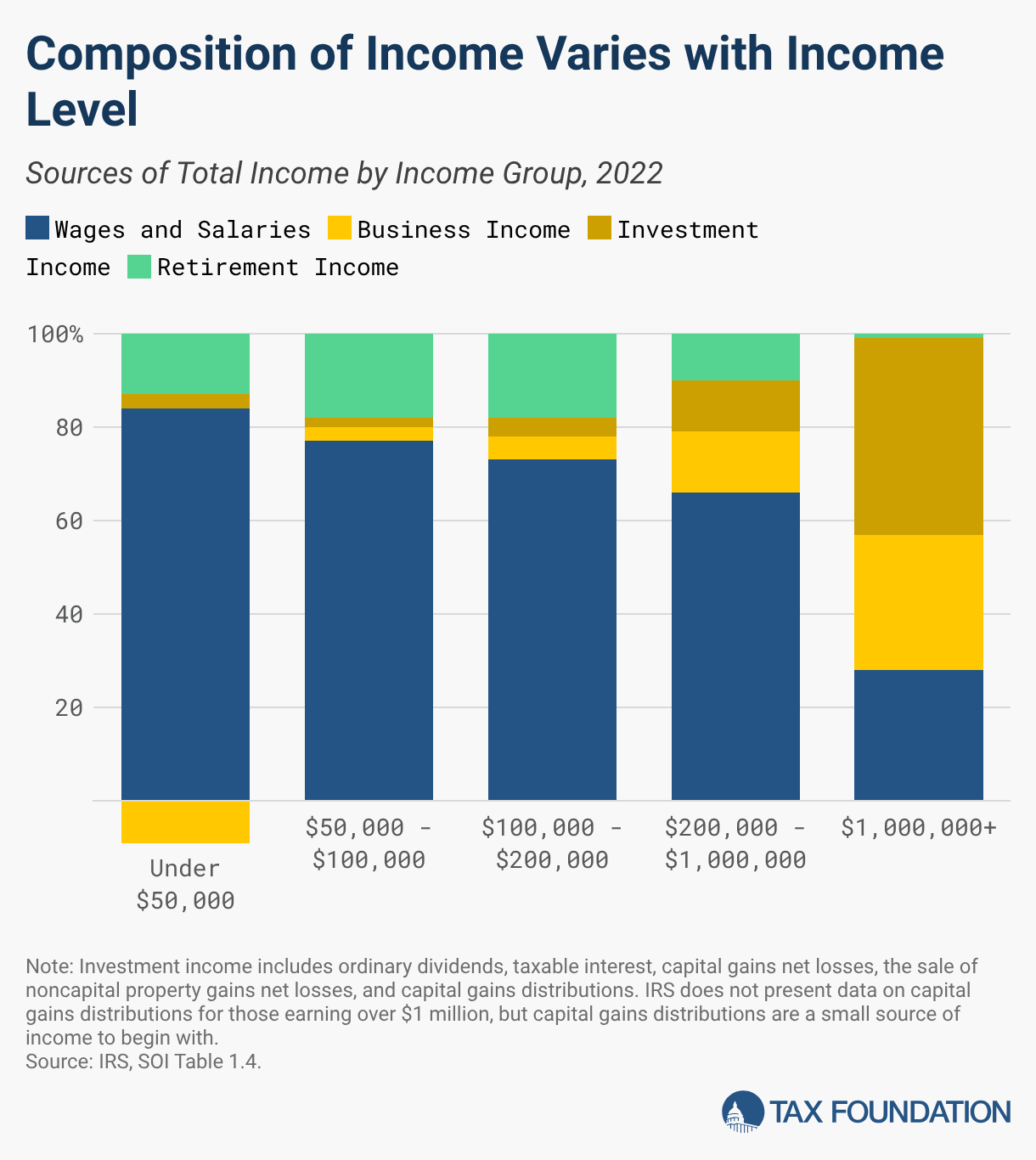
Composition of Income Varies with Income Level
The importance of different sources of income varies by income level. For example, retirement income is most important as a source of income for taxpayers making between $50,000 and $200,000, comprising just under 18 percent of total income for taxpayers in that income range. In practice, of course, a minority of middle-class taxpayers—retirees—rely on retirement income, while the majority of working-age taxpayers do not. Business income and investment income held outside of retirement accounts are most important to higher-income taxpayers, while wages and salaries comprise the largest share of income for lower-income taxpayers.

Impact of the COVID-19 Pandemic and Economic Recovery
Three factors explain the trends in sources of personal income from 2021 to 2022: high inflationInflation is when the general price of goods and services increases across the economy, reducing the purchasing power of a currency and the value of certain assets. The same paycheck covers less goods, services, and bills. It is sometimes referred to as a “hidden tax,” as it leaves taxpayers less well-off due to higher costs and “bracket creep,” while increasing the government’s spendin, a struggling stock market, and declining unemployment.
Personal income increased by 0.27 percent from 2021 to 2022, as a decline in capital gains income largely offset nominal income growth in other areas. The S&P 500 fell almost 20 percent in 2022, resulting in a nearly 40 percent decline in capital gains realizations year over year (falling from $2 trillion in 2021 to $1.2 trillion in 2022). The decline is in stark contrast to the previous year, when capital gains income skyrocketed, increasing by 80 percent from 2020.
At the same time, wages and salaries grew by 7.9 percent year over year, aligning with 2022 inflation. The average wage and salary income reported on returns with positive wages and salaries rose from $71,600 to $75,900, a 6 percent increase. At the same time, the percentage of returns reporting wages and salaries also rose, from 78.4 percent to 79.6 percent.
Relatedly, the other major change in sources of personal income between 2021 and 2022 was a decline in unemployment compensation. The unemployment rate at the start of 2021 was 6.4 percent, and it steadily fell to 3.9 percent by year’s end. In 2022, though, the unemployment rate remained at 4 percent or below the entire year, reaching 3.5 percent by year’s end.
As a result, fewer people reported unemployment compensation, falling from 9.8 percent of returns in 2021 to 2.9 percent of returns in 2022. At the same time, the COVID-era expansions to unemployment compensation expired in late 2021. This helps explain the decline in average unemployment compensation among returns that did claim it: from $13,200 in 2021 to $6,400 in 2022. The combination of fewer and smaller claims explains the 86 percent decline in unemployment compensation: from $209 billion in 2021 to $30 billion in 2022.
Conclusion
The personal income tax is largely a tax on labor, primarily because our personal income is mostly derived from labor. Varied sources of capital income also play a role in American incomes, whether through tax-neutral retirement accounts or through taxable capital gains and dividends. Additionally, because of the unique structure of pass-through taxation, business income also accounts for an important source of personal income. As policymakers consider reforms to the individual income tax, understanding the types of income that make up the individual income tax baseThe tax base is the total amount of income, property, assets, consumption, transactions, or other economic activity subject to taxation by a tax authority. A narrow tax base is non-neutral and inefficient. A broad tax base reduces tax administration costs and allows more revenue to be raised at lower rates. can help them understand the trade-offs of different changes to the tax system.
Stay informed on the tax policies impacting you.
Subscribe to get insights from our trusted experts delivered straight to your inbox.
Share this article
